J Res Clin Med. 13:34565.
doi: 10.34172/jrcm.025.34565
Review Article
Unlocking the power of critical thinking: a systematic review on Iranian nursing students
Mohammadamin Jandaghian-Bidgoli Conceptualization, Data curation, Formal analysis, Funding acquisition, Investigation, Methodology, Project administration, Resources, Software, Supervision, Validation, Visualization, Writing – original draft, Writing – review & editing, 1 
Shedia Jamalnia Conceptualization, Data curation, Formal analysis, Funding acquisition, Investigation, Methodology, Project administration, Resources, Software, Supervision, Validation, Visualization, Writing – original draft, Writing – review & editing, 2, 3
Marzieh Pashmforosh Conceptualization, Data curation, Formal analysis, Funding acquisition, Investigation, Methodology, Supervision, Writing – original draft, Writing – review & editing, 4
Negin Shaterian Conceptualization, Data curation, Formal analysis, Funding acquisition, Investigation, Methodology, Project administration, Writing – original draft, Writing – review & editing, 5
Pouriya Darabiyan Conceptualization, Data curation, Formal analysis, Funding acquisition, Investigation, Methodology, Project administration, Resources, Validation, Visualization, Writing – original draft, Writing – review & editing, 6
Alireza Rafi Conceptualization, Data curation, Formal analysis, Funding acquisition, Investigation, Methodology, Project administration, Resources, Software, Supervision, Validation, Visualization, Writing – original draft, Writing – review & editing, 4, 7, *
Author information:
1Nursing Department, Faculty of Medical Sciences, Tarbiat Modares University, Tehran, Iran
2Department of Nursing and Midwifery, Kaz.C., Islamic Azad University, Kazerun, Iran
3Student Research Committee, Department of E-Learning in Medical Sciences, Virtual School, Center of Excellence in E-Learning, Shiraz University of Medical Sciences, Shiraz, Iran
4Behbahan Faculty of Medical Sciences, Behbahan, Iran
5Student Research Committee, Kashan University of Medical Sciences, Kashan, Iran
6Student Research Committee, Ahvaz Jundishapur University of Medical Sciences, Ahvaz, Iran
7Department of Nursing and Midwifery, Be.C., Islamic Azad University, Behbahan, Iran
Abstract
Introduction:
Recent concerns have surfaced regarding the insufficient development of critical thinking skills among nursing students, resulting in a gap between theoretical knowledge and practical application. This study aimed to address this gap and explore the significance and methods of developing critical thinking among Iranian nursing students.
Methods:
This study followed the PRISMA guidelines to conduct a systematic literature review, using a rigorous method that included document organization, data extraction, quality assessment, and report writing. The search included all observational or interventional studies, with full-text availability in Persian or English languages. Non-original publications were excluded. PubMed, SID, Magiran, and Scopus databases were searched, and the study selection process involved evaluating titles, abstracts, and full texts. Data extraction included analyzing the characteristics of the included studies, while methodological quality assessment employed suitable tools.
Results:
Out of 1314 initially identified articles, a total of 22 high-quality studies were reviewed in this systematic review. These studies, conducted between 2016 to 2022, examined critical thinking in Iranian nursing students. The interventions evaluated various approaches including problem-based learning, conceptual mapping, flipped classroom, clinical reasoning, and team-based learning, while the observational studies explored the association between critical thinking and emotional intelligence, learning styles, and academic performance factors.
Conclusion:
This study underscores the significance of developing critical thinking skills among Iranian nursing students and suggests the effectiveness of utilizing problem-based learning and conceptual mapping strategies in enhancing critical thinking abilities.
Keywords: Critical, Nurse, Students, Thinking
Copyright and License Information
© 2025 The Author(s).
This is an open access article distributed under the terms of the Creative Commons Attribution License (
http://creativecommons.org/licenses/by/4.0/), which permits unrestricted use, distribution, and reproduction in any medium, provided the original work is properly cited.
Funding Statement
This study was funded by Behbahan Faculty of Medical Sciences.
Introduction
Health professionals are supposed to manage health, educational, economic, and social challenges in their professional society. Clinical judgment of nurses is extremely important to meet the needs of their patients.1 Similarly, one of the important goals of nursing education is to train nurses for providing decent services to the society using their knowledge and skills.2 Critical thinking is a type of purposeful and self-regulating judgment forming through clinical reasoning and solving patient's problems.3 In other words, critical thinking is the cognitive process of using purposeful and insightful judgment, including the development and effective application of multiple dimensions of cognition for interpreting and analyzing a situation and achieving a solution.4 The development of intellectual skills of students is a complex issue in education that is in a critical state. In recent years, education experts have expressed concern about students' inability to think critically.5 Based on previous reports, when encountering the problems of patients in critical situations, nurses cannot make appropriate decisions and, in most cases, they merely follow physicians' orders. So, this leads to a decrease in the quality of the services provided.6 Because the traditional education methods did not focus on training the individuals for solving future professional problems in their professional society, critical thinking should be considered a priority in the learning process of students. The existing gap between theory and practice in the areas related to human health is significant. Despite passing many theory units, students are not able to apply their knowledge in clinical situations.7 In 1986, The American Association of Colleges of Nursing (AACN) announced the growth and development of critical thinking skills as an essential component for the evaluation of undergraduate and graduate students. Additionally, AACN introduced critical thinking as a mandatory part of nurse credentialing.8
Nurses play an important role in forming the desired outcomes of all the health care systems around the world.9 The swift alterations in health care systems require flexible, personalized, and decisive reactions by nurses.10 The decision taken by the nurse often involves complex problems related to the physical, mental, and social health conditions of patients and even includes interaction with other systems. The nurses must be able to make complex decisions based on critical thinking via gathering various information and interpreting them in their minds.11 Hence, there should be an appropriate educational program based on critical thinking for nursing students on how to manage tough situations and dilemmas.12 Even, critical thinking is associated with nursing students' academic achievement. 13 There are various ways to develop critical thinking including team-based learning, concept mapping, case studies, and problem-based learning.14 According to evidence, even Florence Nightingale emphasized critical thinking-based teaching methods. Considering the high density of hospital tasks and the acceptance of responsibility for patient care measures by nurses, it is not surprising that patient satisfaction with nursing care is a key indicator of overall hospital satisfaction.15 Notably, the active involvement of nursing students is of great importance and the instructors are the facilitators of critical thinking among the students.16
Normally, nurses execute critical thinking based on two naib factors: cognition and skills. Additionally, the nursing process including discovering information, questioning, analysis, and evaluation can be addressed for teaching critical thinking to nursing students.17 Nursing experts created the Nursing Consensus Statement (NCS) to explain the critical thinking in nurses.16 The NCS consists of 17 items: 10 habits of mind and 7 cognitive skills. The habits of mind comprise perseverance, open-mindedness, flexibility, confidence, creativity, inquisitiveness, reflection, intellectual integrity, intuition, and contextual perspective. On the other hand, cognitive skills consist of information seeking, discriminating, analyzing, transforming knowledge, predicting, applying standards, and logical reasoning.
Although a systematic review has been conducted regarding critical thinking in Iranian nursing students,17 this study aimed to fill the gap concerning critical thinking in Iranian nursing students. Additionally, the methods of developing critical thinking in Iranian nursing students were investigated.
Methods
The study was conducted based on Preferred Reporting Items for Systematic Reviews and Meta-Analyzes (PRISMA) guidelines.18 The systematic review process included the documents organization, data extraction, quality assessment, and writing reports were executed, respectively.
Inclusion criteria
The inclusion criteria for this study were as follows:
-
The study should have been conducted on Iranian nursing students
-
The study has to be observational or interventional.
-
The study should have given information about the various aspects of critical thinking in Iranian nursing students.
-
The full text should have been available in Persian or English languages.
The excluded studies were non-original publications such as reviews, letters to the editor, or abstracts only.
Based on PICO framework, P (Iranian nursing students), I (interventions such as concept mapping, flipped classroom, problem-based), C (traditional learning methods), and O (improvement in critical thinking).
Searching in the databases
The PubMed, SID, Magiran, and Scopus databases were independently searched by two authors from the beginning of 2016 until the end of 2022. The titles and abstracts of the articles were searched using various databases using a combination of the following keywords with search operators (AND, OR): (“Critical thinking*” [tiab] OR “Thinking Skills” [tiab] OR “Thinking Skill” [tiab] OR “Kolb Thought”[tiab] OR “Critical Thinking”[tiab] OR “Thoughts”[tiab]) AND ("medical education"[tiab] OR "medical education"[tiab] OR "nursing education"[tiab] OR "nursing student"[tiab])
Study delection
Initially, the titles and abstracts of included studies were evaluated to determine whether they were eligible. Two authors independently assessed the full text. In terms of any disagreement, the third author resolved it. Additionally, a table was designed to compare the studies based on inclusion criteria.
Data extraction
Two reviewers extracted and descriptively analyzed the characteristics of included studies. First author's name, publication year, sample size, gender, study type, course, measurement tool, analysis method, type of education and main findings.
Assessment of methodological quality
The STROBE (Strengthening the Reporting of Observational Studies in Epidemiology) statement was used for the quality assessment of included observational studies. Basically, it has 22 items used for the assessment.19 The Joanna Briggs Institute Meta-Analysis of Statistics Assessment and Review Instrument (JBI-MAStARI) was used for the assessment of nonrandomized interventional and randomized interventional studies.20 Two authors were responsible for the methodological quality of the included studies. The third author resolved any disagreement between the reviewers.
Results
The search strategy resulted in the retrieval of a total of 1314 articles, of which 22 studies were included in the study. At first, 682 duplicate articles were excluded. Then, 437 articles were removed owing to the lack of relevance. Subsequently, 195 records went through full-text evaluation. Ultimately, 22 high-quality studies on critical thinking in Iranian nursing students (2016 to 2022) were included. Additionally, Figure 1 shows the process of article selection based on the PRISMA protocol. The total sample size was 1838. Three randomised controlled trials, eleven quasi-experimental clinical trials, seven descriptive-correlational studies, and one cross-sectional study made up the total of 22 included papers. Eight observational studies were analysed using the STROBE checklist, as indicated in Table 1, and fourteen interventional or quasi-experimental studies were compiled using the JBI-MAStARI tool, as indicated in Table 2; All 22 included studies are summarised in Table 3. Twenty studies were only conducted on undergraduates. Two studies included both undergraduates and graduate nursing students.
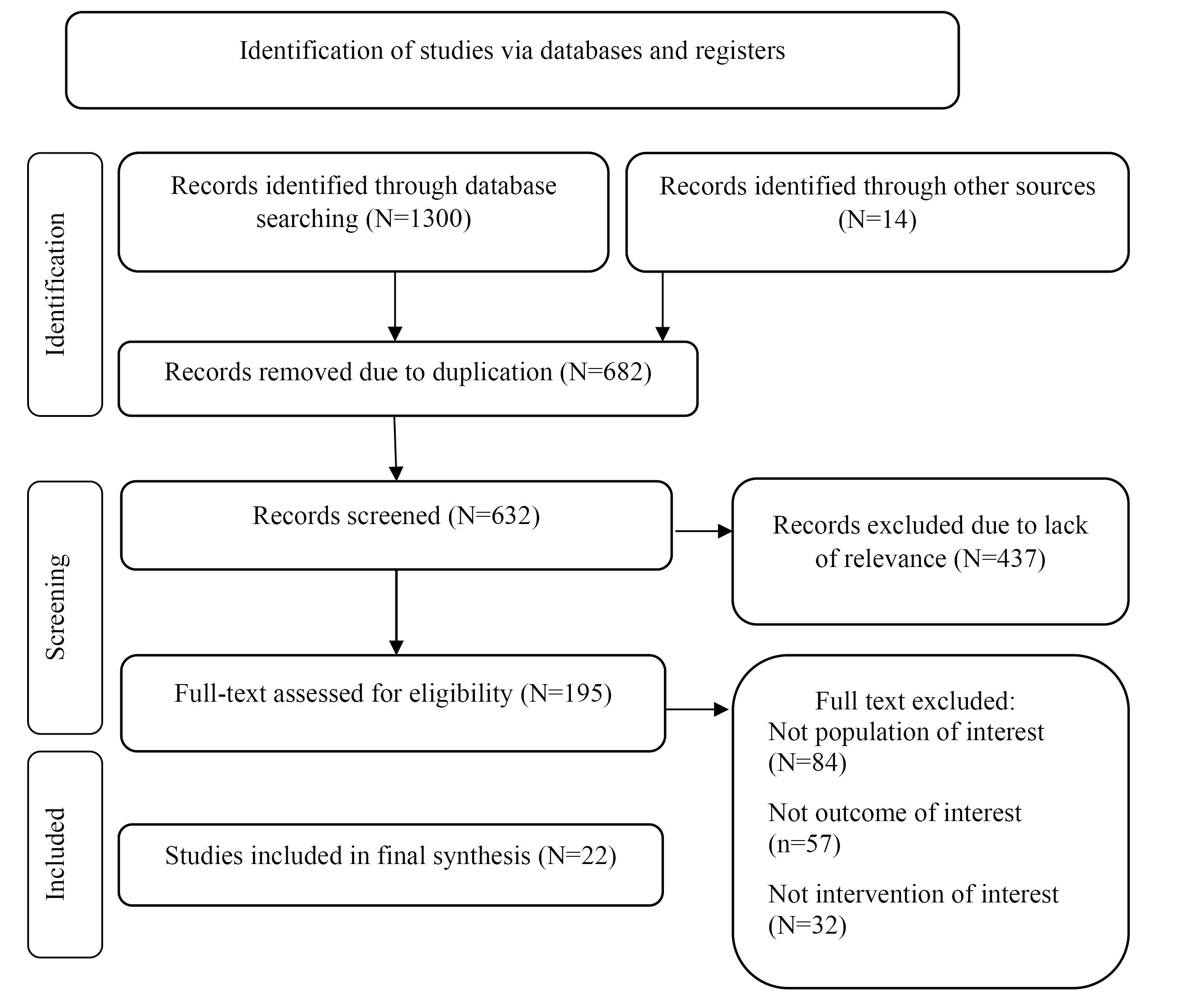
Figure 1.
PRISMA Flowchart of selected studies
.
PRISMA Flowchart of selected studies
Table 1.
The STROBE statement scores
|
Author and year of publication
|
Q1
|
Q2
|
Q3
|
Q4
|
Q5
|
RB
|
| Lotfi et al36 (2020) |
+ |
+ |
? |
+ |
? |
+ |
| Barry et al37 (2020) |
+ |
+ |
? |
? |
+ |
? |
| Bagheri et al34 (2019) |
+ |
? |
? |
? |
+ |
? |
| Shirazi and Heidari38 (2019) |
? |
+ |
? |
+ |
+ |
+ |
| Hasanpour et al35 (2018) |
+ |
+ |
? |
? |
- |
- |
| Orujlu and Hemmati Maslakpak39 (2017) |
+ |
? |
+ |
+ |
? |
? |
| Rasooli et al40 (2016) |
? |
? |
+ |
+ |
- |
- |
| Mousazadeh et al41 (2016) |
? |
+ |
+ |
? |
+ |
+ |
Low risk: +
Moderate risk: ?
High risk: -
Q1: Methods for selecting study participants; Q2: Methods for measuring exposure and outcome variables; Q3: Methods to control confounding; Q4: design-specific sources of bias; Q5: statistical methods; RB: Risk of bias.
Table 2.
Critical appraisal checklist summary for randomized control/pseudo-randomized trials (JBI-MAStARI)
|
Author and year of publication
|
Q1
|
Q2
|
Q3
|
Q4
|
Q5
|
Q6
|
Q7
|
Q8
|
Q9
|
RB
|
| Dehghanzadeh and Moaddab25 (2021) |
+ |
+ |
+ |
+ |
+ |
+ |
? |
+ |
+ |
+ |
| Momeni et al33 (2021) |
+ |
+ |
+ |
+ |
+ |
+ |
? |
+ |
+ |
+ |
| Aein et al21 (2020) |
+ |
- |
+ |
+ |
? |
- |
? |
? |
+ |
? |
| Ahmady and Shahbazi22 (2020) |
+ |
- |
+ |
? |
? |
? |
+ |
+ |
+ |
? |
| Roshangar et al27 (2020) |
+ |
+ |
+ |
+ |
+ |
+ |
? |
? |
- |
- |
| Mohammadi et al26 (2019) |
+ |
- |
? |
+ |
+ |
+ |
+ |
? |
+ |
? |
| Kameli et al32 (2019) |
+ |
+ |
+ |
? |
? |
? |
+ |
+ |
+ |
+ |
| Dehghanzadeh et al31 (2018) |
+ |
+ |
? |
+ |
+ |
? |
+ |
+ |
? |
+ |
| Dehghanzadeh and Jafaraghaie30 (2018) |
+ |
+ |
+ |
+ |
+ |
? |
+ |
+ |
+ |
+ |
| Momeni et al24 (2017) |
+ |
+ |
? |
+ |
+ |
+ |
+ |
? |
? |
+ |
| Sadeghi-Gandomani et al28 (2017) |
+ |
+ |
? |
? |
+ |
? |
+ |
+ |
+ |
+ |
| Sadeghi et al29 (2016) |
+ |
? |
? |
+ |
+ |
+ |
+ |
? |
+ |
? |
| Gholami et al23 (2016) |
+ |
? |
+ |
+ |
+ |
? |
+ |
? |
+ |
? |
| Kuhpayehzadeh et al42 (2016) |
+ |
- |
+ |
+ |
+ |
? |
? |
+ |
+ |
+ |
Low risk: +
Moderate risk: ?
High risk: -
Q1: Was the study based on a random or pseudorandom sample?
Q2: Were the criteria for inclusion in the sample clearly defined?
Q3: Were confounding factors identified and strategies to deal with them stated?
Q4: Were the outcomes assessed using objective criteria?
Q5: If comparisons are being made, was there sufficient description of the groups?
Q6: Was the follow-up carried out over a sufficient time period?
Q7: Were the outcomes of people who withdrew described and included in the analysis?
Q8: Were the outcomes measured in a reliable way?
Q9: was an approximate statistical analysis used?
RB: Risk of bias
Table 3.
Overview of Included Studies
|
Study ID
|
Study Type
|
Sample Size (F/M)
|
Course
|
Measurement Tools
|
Analysis method
|
Type of education
|
Key findings/Main points
|
| Dehghanzadeh and Moaddab25 (2021) |
RCT |
83 (70/13) |
BSN |
The CCTST and a concept map scoring scale |
Chi- square, independent and paired
t- test |
Concept mapping |
simple
-
- significantly higher scores of critical thinking in the intervention group in the areas of analysis (P = 0.046) and deductive reasoning (P = 0.025) compared with the controls
-
- Higher score of nursing process in the intervention group (P < 0.001)
|
| Momeni et al33 (2021) |
RCT |
32 (20/12) |
BSN |
CCTDI |
Independent t- test |
Portfolio and direct observation of procedural
skills model |
simple
-
- Higher tendency to critical thinking in the portfolio group (P ≤ 0.001)
|
| Aein et al21 (2020) |
CT |
48 (48/0) |
BSN |
CCTST |
Paired t-test |
Problem-based |
simple
-
- Significant improvement of critical thinking after intervention (P < 0.05)
-
- Evaluation and inductive reasoning domains did not improve significantly
-
- High level of satisfaction with learning experience in the students
|
| Lotfi et al36 (2020) |
Descriptive and correlational |
164 (100/64) |
BSN |
Creative atmosphere scale and critical thinking scale |
Independent t-test, analysis of variance,
regression coefficient and Pearson correlation coefficient |
NA |
simple
-
- Significant positive relationship between educational atmosphere components of creative educational atmosphere with critical thinking (P = 0.000)
-
- No statistically significant difference between male and female students with regard to critical thinking
-
- Predictive role of creative educational atmosphere components for critical thinking in students
|
| Barry et al. 37 (2020) |
Descriptive correlational |
154 (100/54) |
BSN |
Ricketts’ Critical
Thinking Disposition Assessment Scale and NSCQ |
Pearson’s correlation coefficient |
NA |
simple
-
- A significant, inverse, moderate correlation between critical thinking and professional self-concept (P < 0.001)
-
- The significant effect of sex (P = 0.003), marital status (P = 0.05) and ethnicity (P = 0.003) on critical thinking
|
| Ahmady and Shahbazi22 (2020) |
CT |
40 (24/16) |
BSN |
CCTST |
Independent sampled T-test,
paired T-test, square chi, and Pearson correlation coefficient |
Problem-solving |
simple
-
- Positive effect of the intervention on critical thinking and decision-making (P < 0.05)
-
- No significant alteration in the control group (P > 0.05)
|
| Roshangar et al27 (2020) |
CT |
55 (NR) |
BSN |
CCTST and CASES |
Paired t-test |
Conceptual mapping |
simple
-
- Improvement of the level of critical thinking after the intervention (P = 0.001)
-
- Significant increase in critical thinking in the control group after intervention (P < 0.001)
|
| Mohammadi et al26 (2019) |
CT and case-control |
81 (65/16) |
BSN |
CCTDI |
Paired t-test and independent t-test |
Conceptual mapping |
simple
-
- significantly higher score of critical thinking in the intervention after intervention (P < 0.0001)
-
- Significantly different post-intervention mean scores of two groups (P < 0.05), except for inductive and inference areas (P > 0.05)
|
| Kameli et al32 (2019) |
CT |
27 (0/27) |
BSN |
CCTST |
Paired t-test |
Clinical Reasoning |
simple
-
- Improvement of the score of critical thinking after the intervention (P = 0.047)
|
| Bagheri et al34 (2019) |
Descriptive correlation |
100 (77/23) |
BSN |
CCTST and The EQ-i 2.0 |
Spearman correlation, Pearson correlation, T test and regression model |
NA |
simple
-
- Positive correlation between total critical thinking score and total emotional intelligence score (P < 0.05)
|
| Shirazi and Heidari38 (2019) |
Cross-sectional |
139 (139/0) |
BSN |
CCTST, Kolb's Learning Style Standard Questionnaire |
Student t test, one-way analysis of variance, chi-square, and correlation test |
NA |
simple
-
- Evaluation and analysis subscales as the highest and lowest frequently used, respectively
-
- No statistically significant relationship between learning style and critical thinking (P = 0.74)
|
| Dehghanzadeh et al30 (2018) |
CT |
43 (35/8) |
BSN |
Ricketts’ Critical Thinking Disposition Questionnaire |
One-sample t-test, paired t-test, Pearson correlation coefficient and ANOVA |
Flipped classroom |
simple
-
- Significant improvement of critical thinking disposition and the domain of intellectual engagement (P = 0. 0001)
|
| Hasanpour et al35 (2018) |
Descriptive correlative |
169 (109/61) |
BSN, MSc, Ph.D |
CCTST, Emotional Intelligence Questionnaire |
Pearson correlation coefficient, |
NA |
simple
-
- No significant correlation between the total score of critical thinking skills and emotional intelligence (P = 0.62), except for empathy (P = 0.001)
|
| Dehghanzadeh and Jafaraghaie31 (2018) |
CT |
81 (68/13) |
BSN |
Ricketts’ Critical Thinking Disposition Inventory, |
Paired-sample t, independent-sample t, and chi-square tests |
Flipped classroom |
simple
-
- Higher mean score of critical thinking in the intervention group (P < 0.0001)
|
| Momeni et al24 (2017) |
RCT |
32 (22/10) |
BSN |
CCTDI |
Independent and paired T-test |
Concept mapping and problem-based |
simple
-
- The increase of the total score of critical thinking in both groups (P = 0.001)
-
- higher improvement of critical thinking situation in problem-based learning group in sub-categories including open mindedness, self-confidence, inquisitiveness and maturity
|
| Sadeghi-Gandomani et al. 28 (2017) |
CT |
70 (39/31) |
BSN |
CCTDI |
Independent and paired T-test and chi-squared test |
Concept mapping |
simple
-
- Significant difference between the intervention and conventional group (P = 0.003) after the intervention
|
| Orujlu and Hemmati Maslakpak39 (2017) |
Correlational |
50 (31/19) |
BSN |
CCTDI and SGSES |
Spearman and Pearson correlation coefficient tests |
NA |
simple
-
- positive and significant correlation between critical thinking and self-efficacy of nursing students (P = 0.002)
|
| Sadeghi et al29 (2016) |
CT |
70 (39/31) |
BSN |
CCTDI |
Independent and paired T-test and chi-squared test |
Concept mapping |
simple
-
- Significant difference between the intervention and conventional group (P = 0.003) after the intervention
|
| Rasooli et al40 (2016) |
Descriptive and correlational |
160 (NR) |
BSN and MSc |
CCTDI, Information Literacy Questionnaire and SRQ-A |
Pearson correlation test |
NA |
simple
-
- Significant relationship between critical thinking and information literacy with self-regulation Strategies (P < 0.05)
-
- significant relationship between sub-scale of evaluation, inference, inductive and deductive reasoning with self-regulation (P < 0.05)
|
| Gholami et al23 (2016) |
CT |
40 (25/15) |
MSN |
CCTST-B and MAI |
Paired t-test |
Problem-based |
simple
-
- Significant increase in the overall critical thinking score (P < 0.01) and its sub-scales of evaluation and deduction (P < 0.05) after intervention
-
- Improvement of metacognitive awareness after intervention (P < 0.001)
-
- No significant alterations in the students' critical thinking skills and metacognitive awareness after executing the lecture method (P = 0.314)
|
| Kuhpayehzadeh et al42 (2016) |
CT |
80 (45/35) |
MSN |
Watson-Glaser critical thinking questionnaire |
Independent T-test |
Team-based |
simple
-
- Significant effect of team-based learning on critical thinking of the students (P > 0.05)
-
- Improvement of understanding, identifying assumptions, inferences, interpretation, and evaluation of logical reasoning in the team-based learning group (P < 0.001)
|
| Mousazadeh et al41 (2016) |
Descriptive correlational |
120 (62/58) |
MSN |
Ricketts' Critical Thinking Disposition Questionnaire |
Independent T-test, Pearson correlation test, ANOVA |
NA |
simple
-
- Lack of significant correlation between the scores of students' disposition toward critical thinking and their total average grades (P = 0.85)
-
- No significant association of age, gender, and years of academic study with critical thinking (P > 0.05)
|
CCTST, California Critical Thinking Skills Test; NSCQ, Nurses’ Self-Concept Questionnaire; CASES, College Academic Self-Efficacy Scale; CCTDI, The California Critical Thinking Dispositions Inventory; EQ-i 2.0, Bar-On Emotional Quotient Inventory; SGSES, Sherer's General Self-Efficacy Scale; SRQ-A, Academic Self-Regulation Questionnaire; MAI, Metacognitive Awareness Inventory; BSN, bachelor of science in nursing; MSN, master of science in nursing; CT, clinical trials; RCT, randomized controlled trial; NA, not applicable
The retrieved interventional studies mainly focused on evaluating the effect of problem-based learning,21-24 conceptual mapping,23,25-29 flipped classroom,30,31 clinical reasoning,32 portfolio and direct observation of procedural skills model,33 and team-based learning on critical thinking. Meanwhile, the retrieved observational studies assessed the association of emotional intelligence,34,35 creative education atmosphere,36 professional self-concept,37 learning style and academic achievement,38 self-efficacy,39 self-regulation strategies,40 and academic performance41 with critical thinking in Iranian nursing students. Overall, the results indicated that various types of interventions are effective in improving the level of critical thinking. Therefore, there were promising findings regarding the interventions aimed at improving the critical thinking of Iranian nursing students. Only one study reported that critical thinking scores increased both in the intervention and the control group receiving routine procedures. However, there was an association between critical thinking and demographic variables. For instance, females and single students had lower scores in critical thinking.37 Additionally, the nursing students who participated in conceptual mapping courses, had a higher ability to conduct nursing care plans.25 One study compared the efficacy of problem-based learning and conceptual mapping. Eventually, problem-based learning was more effective in improving the critical thinking level.24 As well, there was no significant association between critical thinking and the type of learning styles.38 Regarding the association of critical thinking with emotional intelligence, the results were inconsistent, as one study claimed a significant association between critical thinking and emotional intelligence.34 However, another study showed that there is no significant correlation between these two components.35
Quality assessment
Table 1 presents an overview of the quality assessment of studies based on the STROBE statement, while Table 2 summarizes the quality assessment results of quasi-experimental and experimental studies.
An overview of the included studies is presented in Table 3.
Discussion
This systematic review aimed to evaluate intervention and factors associated with Iranian nursing students. Most of the retrieved interventional studies demonstrated that specific plans or programs, including problem-based learning and concept mapping, could enhance students’ critical thinking; however, a few studies reported non-significant or mixed findings, such as improvements observed in both intervention and control groups. Besides, the observational studies showed the association of various components with critical thinking. Also, some research have demonstrated the importance of teamwork and collaborative learning in raising critical thinking proficiency.42 In line with the results of this study about effect of problem-based learning on increasing the total score of critical thinking, a study in Saudi Arabia showed that problem-based learning can develop critical thinking in nursing students.43 Similarly, another study revealed that problem-based learning can improve critical thinking through forming discussions, supportive atmosphere, encouraging to discover interest and building trust.44 Consistent with the results of this systematic review regarding the effect of conceptual mapping on improving critical thinking, a study in Turkey proved that using conceptual mapping can lead to an increase in the total score of critical thinking.45 Similarly, a study in the United States revealed that students in the conceptual mapping group achieved higher scores in critical thinking.46 Even, some students were not satisfied with conceptual mapping due to its heavy workload, but it ultimately led to an improvement in their level of critical thinking.47 However, this program can be implemented as a web-based course that can maintain its quality and increase the total score of critical thinking.48 Conceptual mapping creates a network of relationships, allowing students to discover concepts and improve critical thinking through the design of various reasoning maps.49 In other words, the nature of conceptual mapping encourages the learner to acquire more information and it is effective in enhancing the score of critical thinking.50 In this way, the learner can classify new information and connect the old concepts with the new concept.51 However, a study showed that conceptual mapping could not improve critical thinking.52 Similarly, a study on nursing students proved that there was no significant difference between the scores of pre-test and post-test.53 This finding can be related to a small sample size, high score of critical thinking before the intervention, Short intervention period, or group-based conceptual mapping. No study regarding simulation training has been conducted on Iranian nursing students in Iran since 2016. However, studies in other countries showed that simulation is in direct association with an improved level of critical thinking.54 However, another study claimed that simulation can lead to a decreased level of critical thinking.55 As well, simulation-based classes are directly associated with improvement in clinical judgment, self-efficacy, clinical abilities, and self-confidence.56
Without a doubt, enjoyable contexts encourage students to learn new things in a challenging and interactive manner.57 Moreover, interesting educational programs can increase the tendency toward critical thinking, because they can reflect the real cases.58 Problem-based learning or conceptual mapping enables the students to think deeply and organize their thinking.57
The findings of the current study showed that students in lower academic semesters had a lower level of critical thinking ability compared to students who were close to graduation.34 This finding is in line with the results of previous studies.59 However, some studies on nursing students showed no association between the semester and critical thinking.2 The results regarding the association of emotional intelligence with critical thinking were contradictory. Similarly, previous research showed no significant association between these two components.60 Additionally, other studies claimed that there was a correlation between emotional intelligence and critical thinking.61 It is proved that integration of emotional intelligence into nursing education can lead to better professional performance. In this situation, the students will be able to handle the emotional conditions. As well, emotional intelligence is associated with better performance of students.62 Seemingly, the development of critical thinking requires a long period to develop. Students who are spending the beginning and end of the academic year, possess a lower level of critical thinking disposition.63 As well, most of the studies indicated that nursing students' critical thinking was moderate to low.61-64 Even, a study on nurses showed that they had moderate critical thinking. Therefore, the intervention should be designed to enhance the students critical thinking. This study found an association between critical thinking and socio-demographic variables, which is in line with a study conducted in Spain.65 On the contrary, a study in Turkey found no association between critical thinking and socio-demographics in nursing students.66 Regarding the educational level, it was found that postgraduate students achieved higher critical thinking scores.13 Additionally, some studies pointed out that clinical practice should offer a supportive environment that encourages critical thinking and questioning, and that stresses the use of multiple sources of knowledge, with special attention paid to the role of reflective writing as a pathway to enhance critical thinking, in order to utilize the competencies and skills of recently graduated nurses in evidence-based practice.67,68
Limitations
Despite the efforts made by the authors, some undeniable limitations should be addressed. English and Persian articles were the only sources owing to the inclusion criteria. Also, dissertations, books, and grey literature were excluded in this systematic review. Additionally, only studies published from 2016 to 2022 were included. Few studies were methodologically inappropriate, but none of them were excluded.
Conclusion
It is of great importance to use the methods to promote the critical thinking level in the nursing students. As well, the associated factors with critical thinking should not be neglected. There was a vast heterogeneity in the included studies that were related to critical thinking in Iranian nursing students. The intervention used in the included studies could significantly increase the total score of critical thinking.
This review highlights systematic review as an appropriate approach for nursing educators to assist undergraduate and post-graduate nursing students.
Competing Interests
The authors state no conflicts of interest in this study.
Ethical Approval
This study was approved by the Ethics Committee of Behbahan Faculty of Medical Sciences (Ethical Code:IR.BHN.REC.1402.036).
Acknowledgements
The study was also registered at Prospero (ID: CRD42023389637). The authors sincerely thank those who helped the authors with this research.
References
- Carter AG, Creedy DK, Sidebotham M. Critical thinking skills in midwifery practice: development of a self-assessment tool for students. Midwifery 2017; 50:184-92. doi: 10.1016/j.midw.2017.04.010 [Crossref] [ Google Scholar]
- Azizi-Fini I, Hajibagheri A, Adib-Hajbaghery M. Critical thinking skills in nursing students: a comparison between freshmen and senior students. Nurs Midwifery Stud 2015; 4(1):e25721. doi: 10.17795/nmsjournal25721 [Crossref] [ Google Scholar]
- Habibzadeh H, Khajehali N, Khalkhali HR, Mohammadpour Y. Effect of evidence-based nursing training on nursing students ability in executive skill of nursing process in Urmia University of Medical Sciences, 2013. Nurs Midwifery J 2013;11(4):284-92. [Persian].
- Facione PA. Critical thinking: what it is and why it counts. Insight Assessment 2011; 1(1):1-23. [ Google Scholar]
- Ghanbari A, Monfared A, Hoseinzadeh T, Moaddab F, Sedighi A. The impact of the nursing process education on critical thinking of nursing students. Res Med Educ 2017; 9(2):25-33. doi: 10.29252/rme.9.2.33 [Crossref] [ Google Scholar]
- Nibbelink CW, Brewer BB. Decision-making in nursing practice: an integrative literature review. J Clin Nurs 2018; 27(5-6):917-28. doi: 10.1111/jocn.14151 [Crossref] [ Google Scholar]
- Tiffen J, Corbridge SJ, Slimmer L. Enhancing clinical decision making: development of a contiguous definition and conceptual framework. J Prof Nurs 2014; 30(5):399-405. doi: 10.1016/j.profnurs.2014.01.006 [Crossref] [ Google Scholar]
- Vacek JE. Using a conceptual approach with concept mapping to promote critical thinking. J Nurs Educ 2009; 48(1):45-8. doi: 10.3928/01484834-20090101-11 [Crossref] [ Google Scholar]
- Considine J, Berry D, Allen J, Hewitt N, Oldland E, Sprogis SK. Team-based learning in nursing education: a scoping review. J Clin Nurs 2021; 30(7-8):903-17. doi: 10.1111/jocn.15599 [Crossref] [ Google Scholar]
- Zuriguel-Pérez E, Lluch-Canut MT, Puig-Llobet M, Basco-Prado L, Almazor-Sirvent A, Biurrun-Garrido A. The nursing critical thinking in clinical practice questionnaire for nursing students: a psychometric evaluation study. Nurse Educ Pract 2022; 65:103498. doi: 10.1016/j.nepr.2022.103498 [Crossref] [ Google Scholar]
- Tourani S, Ahmadi B, Karami A. The correlation between nurses’ conflict and head nurses’ emotional intelligence in the emergency ward of teaching hospitals affiliated to Iran University of Medical Sciences. Journal of Health Promotion Management 2014;3(3):37-46. [Persian].
- Wong SH, Kowitlawakul Y. Exploring perceptions and barriers in developing critical thinking and clinical reasoning of nursing students: a qualitative study. Nurse Educ Today 2020; 95:104600. doi: 10.1016/j.nedt.2020.104600 [Crossref] [ Google Scholar]
- Pitt V, Powis D, Levett-Jones T, Hunter S. The influence of critical thinking skills on performance and progression in a pre-registration nursing program. Nurse Educ Today 2015; 35(1):125-31. doi: 10.1016/j.nedt.2014.08.006 [Crossref] [ Google Scholar]
- Sharma S, Saragih ID, Tarihoran D, Chou FH. Outcomes of problem-based learning in nurse education: a systematic review and meta-analysis. Nurse Educ Today 2023; 120:105631. doi: 10.1016/j.nedt.2022.105631 [Crossref] [ Google Scholar]
- Westerdahl F, Carlson E, Wennick A, Borglin G. Teaching strategies and outcome assessments targeting critical thinking in bachelor nursing students: a scoping review protocol. BMJ Open 2020; 10(1):e033214. doi: 10.1136/bmjopen-2019-033214 [Crossref] [ Google Scholar]
- Scheffer BK, Rubenfeld MG. A consensus statement on critical thinking in nursing. J Nurs Educ 2000; 39(8):352-9. doi: 10.3928/0148-4834-20001101-06 [Crossref] [ Google Scholar]
- Khandan M, Nouhi E, Sabzevari S. The necessity of critical thinking in nursing education: review of literature. Iranian Journal of Systematic Review in Medical Sciences 2020;1(1):48-60. [Persian].
- Liberati A, Altman DG, Tetzlaff J, Mulrow C, Gøtzsche PC, Ioannidis JP. The PRISMA statement for reporting systematic reviews and meta-analyses of studies that evaluate health care interventions: explanation and elaboration. J Clin Epidemiol 2009; 62(10):e1-34. doi: 10.1016/j.jclinepi.2009.06.006 [Crossref] [ Google Scholar]
- von Elm E, Altman DG, Egger M, Pocock SJ, Gøtzsche PC, Vandenbroucke JP. The Strengthening the Reporting of Observational Studies in Epidemiology (STROBE) Statement: guidelines for reporting observational studies. Int J Surg 2014; 12(12):1495-9. doi: 10.1016/j.ijsu.2014.07.013 [Crossref] [ Google Scholar]
- Aromataris E, Fernandez R, Godfrey CM, Holly C, Khalil H, Tungpunkom P. Summarizing systematic reviews: methodological development, conduct and reporting of an umbrella review approach. Int J Evid Based Healthc 2015; 13(3):132-40. doi: 10.1097/xeb.0000000000000055 [Crossref] [ Google Scholar]
- Aein F, Hosseini R, Naseh L, Safdari F, Banaian S. The effect of problem-solving-based interprofessional learning on critical thinking and satisfaction with learning of nursing and midwifery students. J Educ Health Promot 2020; 9:109. doi: 10.4103/jehp.jehp_640_19 [Crossref] [ Google Scholar]
- Ahmady S, Shahbazi S. Impact of social problem-solving training on critical thinking and decision making of nursing students. BMC Nurs 2020; 19:94. doi: 10.1186/s12912-020-00487-x [Crossref] [ Google Scholar]
- Gholami M, Kordestani Moghadam P, Mohammadipoor F, Tarahi MJ, Sak M, Toulabi T. Comparing the effects of problem-based learning and the traditional lecture method on critical thinking skills and metacognitive awareness in nursing students in a critical care nursing course. Nurse Educ Today 2016; 45:16-21. doi: 10.1016/j.nedt.2016.06.007 [Crossref] [ Google Scholar]
- Momeni H, Salehi A, Sadeghi H. Comparing the effect of problem-based learning and concept mapping on critical thinking disposition of nursing student. Education Strategies in Medical Sciences 2017;10(4):234-44. [Persian].
- Dehghanzadeh S, Moaddab F. The effect of concept mapping on nursing students' critical thinking skills and nursing care plan design. Res Med Educ 2021; 13(2):26-35. doi: 10.52547/rme.13.2.26 [Crossref] [ Google Scholar]
- Mohammadi F, Momennasab M, Rostambeygi P, Ghaderi S, Mousazadeh S. The effect of education through conceptual mapping on critical thinking of nursing students. J Pak Med Assoc 2019; 69(8):1094-8. [ Google Scholar]
- Roshangar F, Fathi Azar E, Sarbakhsh P, Azarmi R. The effect of case-based learning with or without conceptual mapping method on critical thinking and academic self-efficacy of nursing students. J Biochem Technol 2020; 11(1):37-44. doi: 10.51847/QIncB86 [Crossref] [ Google Scholar]
- Sadeghi-Gandomani HR, Naseri Borujeni N, Rasoulzadeh N, Delaram M. Comparison of concept mapping and conventional teaching methods on critical thinking skills of nursing students. J Med Educ Dev 2017;9(24):44-55. [Persian].
- Sadeghi H, Shahbazi S, Naseri Borujeni N, Pooiesh V. Comparison of the effects of concept mapping and conventional teaching methods on critical thinking of nursing students. J Nurs Educ 2016; 5(4):27-33. doi: 10.21859/jne-05044 [Crossref] [ Google Scholar]
- Dehghanzadeh S, Jafaraghaee F, Khordadi Astane H. The effect of flipped classroom on critical thinking disposition in nursing students. Iran J Med Educ 2018;18(81):39-48. [Persian].
- Dehghanzadeh S, Jafaraghaee F. Comparing the effects of traditional lecture and flipped classroom on nursing students' critical thinking disposition: a quasi-experimental study. Nurse Educ Today 2018; 71:151-6. doi: 10.1016/j.nedt.2018.09.027 [Crossref] [ Google Scholar]
- Kameli S, Aliyari S, Habibi H, Pishgooie SA. The effect of teaching clinical reasoning on critical thinking of undergraduate nursing students taking the course of emergency nursing in disasters and events: a preliminary study. Mil Caring Sci 2019; 6(3):207-14. doi: 10.29252/mcs.6.3.6 [Crossref] [ Google Scholar]
- Momeni H, Kerami A, Mirshekari L, Shahsavari Z, Shokhmgar Z, Sanagoo A. Comparing the efficacy of portfolio and direct observation of procedural skills (DOPS) model, on nursing students disposition toward critical thinking. Res Med Educ 2021; 13(2):47-57. doi: 10.52547/rme.13.2.47 [Crossref] [ Google Scholar]
- Bagheri M, Ghaedi Heidari F, Malchi F, Rabiei Z. The relationship between emotional intelligence components and critical thinking in nursing and midwifery students of Bushehr University of Medical Sciences. Nurs Midwifery J 2019;17(2):102-10. [Persian].
- Hasanpour M, Bagheri M, Ghaedi Heidari F. The relationship between emotional intelligence and critical thinking skills in Iranian nursing students. Med J Islam Repub Iran 2018; 32:40. doi: 10.14196/mjiri.32.40 [Crossref] [ Google Scholar]
- Lotfi A, Rezvani A, Ajam A. The role of creative educational atmosphere on critical thinking among students of Qaen nursing and midwifery faculty. Educ Dev Judishapur 2020; 11(2):106-18. doi: 10.22118/edc.2019.201742.1148 [Crossref] [ Google Scholar]
- Barry A, Parvan K, Jabbarzadeh Tabrizi f, Sarbakhsh P, Safa B, Allahbakhshian A. Critical thinking in nursing students and its relationship with professional self-concept and relevant factors. Res Dev Med Educ 2020; 9(1):7. doi: 10.34172/rdme.2020.007 [Crossref] [ Google Scholar]
- Shirazi F, Heidari S. The relationship between critical thinking skills and learning styles and academic achievement of nursing students. J Nurs Res 2019; 27(4):e38. doi: 10.1097/jnr.0000000000000307 [Crossref] [ Google Scholar]
- Orujlu S, Hemmati Maslakpak M. Assessing the relationship between critical thinking and self-efficacy of nursing student. J Nurs Educ 2017; 5(6):11-7. doi: 10.21859/jne-05062 [Crossref] [ Google Scholar]
- Rasooli B, Goudarzi H, Rahmati Najarkolaei F, Momivand R. Relationship between critical thinking and information literacy with self-regulation strategies in nursing students. Health Res J 2017;2(1):25-31. [Persian].
- Mousazadeh S, Momennasab M, Bakhtiari T, Reisi M. Nursing students’ disposition toward critical thinking and its relationship with their academic performance. J Nurs Educ 2016; 5(4):20-6. doi: 10.21859/jne-05043 [Crossref] [ Google Scholar]
- Kuhpayehzadeh Isfahani J, Jazayeri S, Aryaeian N, Karami Aqhqhalleh H. The effect of team-based learning on critical thinking of nursing students at Iran University of Medical Sciences in 2014. J Med Educ Dev 2017;11(3):186-200. [Persian].
- Al-Najar H, Khalil A, Abu Baka SA, Abdul Aziz NS. Problem-based learning (PBL) versus lecture-based learning (LBL): effect on the development of critical thinking, problem solving and self-directive learning skills in nursing students. J Nurs Care 2019; 8(3):489. [ Google Scholar]
- El-Shaer A, Gaber H. Impact of problem-based learning on students critical thinking dispositions, knowledge acquisition and retention. J Educ Pract 2014; 5(14):74-83. [ Google Scholar]
- Bilik Ö, Kankaya EA, Deveci Z. Effects of web-based concept mapping education on students' concept mapping and critical thinking skills: a double blind, randomized, controlled study. Nurse Educ Today 2020; 86:104312. doi: 10.1016/j.nedt.2019.104312 [Crossref] [ Google Scholar]
- Kaddoura M, Van-Dyke O, Yang Q. Impact of a concept map teaching approach on nursing students' critical thinking skills. Nurs Health Sci 2016; 18(3):350-4. doi: 10.1111/nhs.12277 [Crossref] [ Google Scholar]
- Chen SL, Liang T, Lee ML, Liao IC. Effects of concept map teaching on students' critical thinking and approach to learning and studying. J Nurs Educ 2011; 50(8):466-9. doi: 10.3928/01484834-20110415-06 [Crossref] [ Google Scholar]
- McCrow J, Sullivan KA, Beattie ER. Delirium knowledge and recognition: a randomized controlled trial of a web-based educational intervention for acute care nurses. Nurse Educ Today 2014; 34(6):912-7. doi: 10.1016/j.nedt.2013.12.006 [Crossref] [ Google Scholar]
- Toulmin SE. The Uses of Argument. Cambridge University Press; 2003.
- Babamohammadi H, Khalili H. Critical thinking skills of nursing students in Semnan University of Medical Sciences. Iran J Med Educ 2004;4(2):23-31. [Persian].
- Rahmani A, Mohajjel Aghdam A, Fathi Azar E, Abdullahzadeh F. Comparing the effects of concept mapping and integration method on nursing students' learning in nursing process course in Tabriz University of Medical Sciences. Iran J Med Educ 2007;7(1):41-9. [Persian].
- Bixler GM, Brown A, Way D, Ledford C, Mahan JD. Collaborative concept mapping and critical thinking in fourth-year medical students. Clin Pediatr (Phila) 2015; 54(9):833-9. doi: 10.1177/0009922815590223 [Crossref] [ Google Scholar]
- Wheeler LA, Collins SK. The influence of concept mapping on critical thinking in baccalaureate nursing students. J Prof Nurs 2003; 19(6):339-46. doi: 10.1016/s8755-7223(03)00134-0 [Crossref] [ Google Scholar]
- Adib-Hajbaghery M, Sharifi N. Effect of simulation training on the development of nurses and nursing students' critical thinking: a systematic literature review. Nurse Educ Today 2017; 50:17-24. doi: 10.1016/j.nedt.2016.12.011 [Crossref] [ Google Scholar]
- Chiang VC, Chan SS. An evaluation of advanced simulation in nursing: a mixed-method study. Collegian 2014; 21(4):257-65. doi: 10.1016/j.colegn.2013.05.003 [Crossref] [ Google Scholar]
- Ahn H, Kim HY. Implementation and outcome evaluation of high-fidelity simulation scenarios to integrate cognitive and psychomotor skills for Korean nursing students. Nurse Educ Today 2015; 35(5):706-11. doi: 10.1016/j.nedt.2015.01.021 [Crossref] [ Google Scholar]
- Lee LC, Hao KC. Designing and evaluating digital game-based learning with the ARCS motivation model, humor, and animation. Int J Technol Hum Interact 2015; 11(2):80-95. doi: 10.4018/ijthi.2015040105 [Crossref] [ Google Scholar]
- Chang CY, Kao CH, Hwang GJ, Lin FH. From experiencing to critical thinking: a contextual game-based learning approach to improving nursing students’ performance in electrocardiogram training. Educ Technol Res Dev 2020; 68(3):1225-45. doi: 10.1007/s11423-019-09723-x [Crossref] [ Google Scholar]
- Khalili H, Babamohammadi H, Haji Aghajani S. The effects of two educational methods, classic and critical thinking strategies, on the stable learning of nursing students. Koomesh 2004;5(2):53-62. [Persian].
- Kim SH, Shin S. Social-emotional competence and academic achievement of nursing students: a canonical correlation analysis. Int J Environ Res Public Health 2021; 18(4):1752. doi: 10.3390/ijerph18041752 [Crossref] [ Google Scholar]
- Kaya H, Şenyuva E, Bodur G. Developing critical thinking disposition and emotional intelligence of nursing students: a longitudinal research. Nurse Educ Today 2017; 48:72-7. doi: 10.1016/j.nedt.2016.09.011 [Crossref] [ Google Scholar]
- Dugué M, Sirost O, Dosseville F. A literature review of emotional intelligence and nursing education. Nurse Educ Pract 2021; 54:103124. doi: 10.1016/j.nepr.2021.103124 [Crossref] [ Google Scholar]
- Eren Fidancı B, Çınar Fİ, Yıldız D, Akar F, Türk A, Tuncer S. Evaluation of the critical thinking skills and factors affecting these skills in students of high school nursing. Gulhane Med J 2012; 54(1):35-9. [ Google Scholar]
- Bulut S, Ertem G, Sevil Ü. Examination of nursing students' level of critical thinking. Dokuz Eylul University School of Nursing Electronic Journal 2009; 2(2):27-38. [ Google Scholar]
- Zuriguel-Pérez E, Falcó-Pegueroles A, Agustino-Rodríguez S, Del Carmen Gómez-Martín M, Roldán-Merino J, Lluch-Canut MT. Clinical nurses's critical thinking level according to sociodemographic and professional variables (phase II): a correlational study. Nurse Educ Pract 2019; 41:102649. doi: 10.1016/j.nepr.2019.102649 [Crossref] [ Google Scholar]
- Fertelli TK. Peer assessment in learning of nursing process: critical thinking and peer support. Int J Caring Sci 2019; 12(1):331-9. [ Google Scholar]
- Naber J, Wyatt TH. The effect of reflective writing interventions on the critical thinking skills and dispositions of baccalaureate nursing students. Nurse Educ Today 2014; 34(1):67-72. doi: 10.1016/j.nedt.2013.04.002 [Crossref] [ Google Scholar]
- Voldbjerg SL, Grønkjaer M, Sørensen EE, Hall EO. Newly graduated nurses' use of knowledge sources: a meta-ethnography. J Adv Nurs 2016; 72(8):1751-65. doi: 10.1111/jan.12914 [Crossref] [ Google Scholar]